


Your AC dies at 10 PM on the hottest night in July. The house is already 85°F, the kids are restless, and you have no idea if you need a $40 capacitor or a $4,000 compressor. Here’s everything you actually need to know right now.
I’ve talked to a lot of HVAC technicians over the years, and nearly all of them say the same thing: most emergency calls involve problems that either could have been prevented with simple maintenance or — and this one stings could have waited until morning if the homeowner knew what to look for. Neither group should feel bad about that. Air conditioning is one of those systems people don’t think about until it stops working.
This guide won’t talk down to you. It’ll walk you through the quick checks, tell you when calling a 24/7 service is genuinely necessary, explain what a fair repair bill looks like, and help you avoid the handful of scammy practices that pop up during heat waves when people are desperate.
How Bad Is It, Really? Knowing When to Panic
Not every AC failure is an emergency. That might sound obvious, but when your house is 90°F and rising, your brain starts treating everything like a five-alarm fire. So let’s be clear about what actually warrants an after-hours call.
True Emergencies — Call Right Now
- Burning, electrical, or chemical smell coming from the unit or vents
- Breaker trips repeatedly after reset — this means something is actively pulling too much current
- Active water leak pooling near the air handler and approaching electronics or drywall
- Indoor temps above 90°F with elderly adults, infants, or people with respiratory conditions in the home
- Refrigerant hissing — you may smell something faintly sweet; don’t linger near the unit
Urgent but Not Middle-of-the-Night
- Warm air blowing but no unusual smell or electrical behavior
- Weak airflow across all vents
- Thermostat not communicating with the unit
- A frozen coil that’s thawing without leaking into finished spaces
⚠️ Heat Safety Threshold
The CDC considers sustained indoor temperatures above 90°F a health risk, especially for people over 65, children under 4, and anyone on diuretics or blood pressure medication. If your home hits that range and you can’t bring it down with fans and open windows, that’s a genuine emergency — and you should also consider temporary relocation to a cool space while you wait for a tech.
Before You Call Anyone: The 10-Minute Triage
I know you want to skip straight to dialing a number, but a few minutes of checks can save you a $150 diagnostic fee and the embarrassment of a technician pointing at your tripped breaker. Run through these quickly — if anything feels unsafe, stop immediately.
Thermostat First
It sounds almost insultingly basic, but thermostats cause more “AC failures” than most people realize. Set it to COOL, fan to AUTO, and drop the setpoint 5°F below the current room temperature. If your thermostat takes batteries, swap them — dead batteries are a genuinely common culprit, especially on older units. Also check whether the display is blank or showing an error code; if it is, photograph it before you call.
Check the Breakers
Go to your electrical panel and look for the breaker labeled “AC,” “Condensing Unit,” or “Air Handler” — sometimes there are two separate breakers for the same system. If one is tripped (usually sitting between ON and OFF), reset it once. Just once. If it trips again within a few minutes, stop. A breaker that won’t hold is telling you something is wrong, and forcing it is how you turn a capacitor problem into a fire.
The Filter and Airflow Check
Pull your air filter. If you can’t see light through it, it’s clogged. A dirty filter restricts airflow so severely it can cause the evaporator coil to freeze solid — and a frozen coil will make your system blow warm air or shut down completely, which looks exactly like a major failure. Replace or remove the filter temporarily, turn the system off for 2 hours to let any ice melt, then try again.
Walk Outside
Give your condenser unit a quick look. Is the fan running? Is there debris — leaves, plastic, a bird nest — blocking the top or sides? Condensers need 2 feet of clearance all around. If the fan isn’t spinning but you can hear a faint hum, that’s a strong indicator of a failed start capacitor — which is a fast, inexpensive fix, but still needs a tech.
✅ Quick Wins Checklist
- Thermostat set to COOL, fan to AUTO, setpoint lowered 5°F
- Thermostat batteries replaced
- Breaker checked and reset once only
- Air filter inspected and replaced if clogged
- Condensate drain pan checked for overflow
- Outdoor unit cleared of debris, fan observed
- All supply vents confirmed open and unblocked
What Emergency AC Repair Actually Involves
Most after-hours calls fall into a surprisingly short list of problems. Here’s what techs actually find when they show up at midnight.
Capacitor Failure
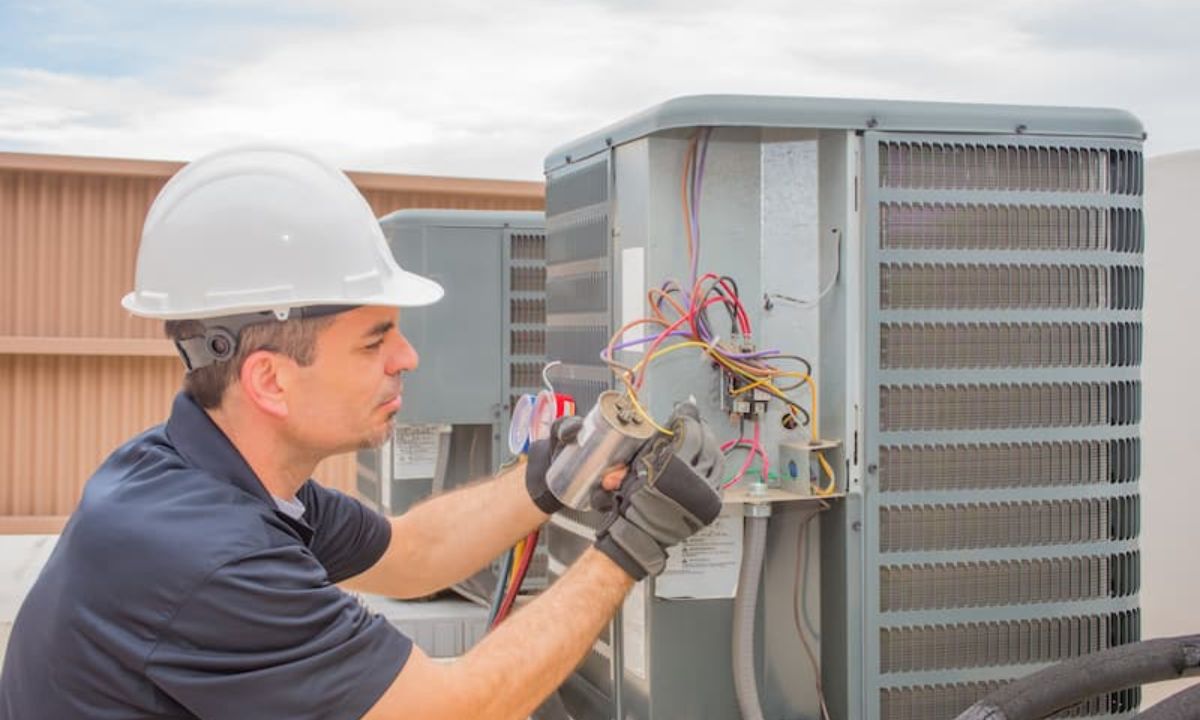
This is the single most common emergency repair, and if you’ve ever heard your outdoor unit humming but not starting, there’s a good chance a capacitor is to blame. Capacitors store the electrical charge that kicks the compressor and fan motor into motion. They degrade over time — heat accelerates the process — and when they fail, the motor hums but can’t turn over. The good news: capacitors are cheap ($10–$40 in parts) and a skilled tech can replace one in 20 minutes.
Contactor Failure
The contactor is essentially a heavy-duty relay switch inside the condenser that routes power to the compressor and fan. When it fails, the outdoor unit won’t come on at all even though the thermostat is calling for cooling. Contactors also wear out from repeated cycling and can get “pitted” from electrical arcing. Another quick, inexpensive fix when diagnosed correctly.
Refrigerant Leak
Low refrigerant — people often call it “Freon” though that specific brand has been phased out — is trickier. The system wasn’t designed to consume refrigerant; if it’s low, it leaked somewhere. A good tech will find and fix the leak first, then recharge the system. Be very skeptical of anyone who only wants to “top it off.” That approach is a band-aid that’ll cost you again in six months, and it’s also technically an EPA violation on sealed systems.
Frozen Evaporator Coil
Restricted airflow, low refrigerant, or a dirty coil can all cause the evaporator the indoor coil to drop below freezing and ice over. When that happens, you get either warm air or no airflow at all. The fix depends on the cause: dirty filter means clean or replace it, low refrigerant means find the leak, blower motor issue means the motor. Defrost time is 2–4 hours, so this repair often stretches into a multi-visit situation if parts are needed.
Condensate Drain Blockage
Your air conditioner removes humidity from the air, and that water has to go somewhere, usually through a PVC drain line. Algae, mold, and sludge build up in that line over time. When it clogs, the condensate pan fills up and either triggers a float switch (shutting the system off) or overflows. You might first notice this as water stains on your ceiling near the air handler. This is preventable with quarterly drain maintenance but very common in humid climates.
The Real Cost of After-Hours AC Repair
Let’s talk money. Emergency HVAC rates are legitimately higher than normal business-hours rates, and that’s fair — you’re paying for a tech to leave their home at 11 PM and drive to yours. But “higher” shouldn’t mean “whatever we feel like charging.”
| Repair Type | Parts Cost | Typical Total (After-Hours) |
| Capacitor replacement | $10–$50 | $150–$350 |
| Contactor replacement | $15–$60 | $175–$400 |
| Drain line clearing | — | $100–$250 |
| Thermostat replacement | $30–$200 | $200–$450 |
| Refrigerant leak + recharge | $150–$400 | $400–$900+ |
| Fan motor replacement | $100–$300 | $350–$800 |
| Compressor replacement | $500–$1,500 | $1,200–$2,500+ |
The diagnostic fee alone — before any work is done — often runs $75–$150 during normal hours and $150–$250 after hours. That’s normal. What’s not normal: a tech who arrives and immediately tells you the compressor is dead without testing anything else. Compressor diagnoses should involve pressure testing and electrical checks, not a five-second look.
Pros and Cons of Emergency AC Repair Services
✅ Pros
- Restores cooling within hours, not days
- Prevents secondary damage from leaks, humidity, or electrical issues
- Protects vulnerable household members from dangerous heat
- Most emergency fixes (capacitor, drain, contactor) are fast and affordable
- Reputable services carry common parts on the van — one-trip repair
❌ Cons
- After-hours rates are meaningfully higher — 1.5–2× standard pricing
- Demand spikes during heat waves stretch wait times to 4–6+ hours
- Harder to verify contractor quality under time pressure
- Some companies use emergencies as upsell opportunities
- Unusual parts may not be on the van, requiring a return visit anyway
How to Choose the Right Emergency AC Repair Company
When you’re sweating through a 95°F night, it’s tempting to just call the first number that pops up in Google. Resist that urge for about five minutes. It’s worth it.
What to Look For
- Licensed and insured in your state this is non-negotiable. Ask for the license number and verify it online if you have time.
- Real-time ETAs a company with a dispatch team should be able to tell you when the tech will arrive, not just “sometime tonight.
- Transparent pricing they should be able to give you a diagnostic fee upfront and explain how labor and parts are billed.
- Warranty on parts and labor at minimum 30 days on labor, 1 year on parts is reasonable.
- Stocked vans ask if they carry common parts. The best services do.
Red Flags That Should Make You Hang Up
- Refusing to give a diagnostic fee estimate over the phone
- Immediately recommending full replacement without completing diagnosis
- Offering to recharge refrigerant without mentioning a leak search
- No physical business address or only a Google Voice number
- Pressure to sign anything before the tech finishes their assessment
A good tech asks questions before they arrive. A great one already has the parts.
Staying Safe While You Wait for the Technician
The hour or two between your call and the tech’s arrival matters. Here’s how to handle it without making things worse.
- If you smell burning or see sparks: shut the system off at the breaker and keep it off. Don’t try to reset it again.
- If water is leaking: shut the system down to stop adding more condensate, place towels under the air handler, and check if the leak is near any light fixtures or electrical panels. If it is, cut that circuit.
- To cool the space: close blinds and curtains (especially south- and west-facing windows), run ceiling fans counter-clockwise, and use portable fans to move air. Cross-ventilation, one fan blowing in, one window open elsewhere, works surprisingly well after sundown.
- For vulnerable people: a damp towel on the neck and wrists, cool (not ice cold) water to drink, and a move to the coolest room in the house can make a meaningful difference.
- Give the tech access: clear a path to the air handler and make sure the outdoor unit is accessible. Note where the disconnect switch, main electrical panel, and water shutoff are, the tech will likely need all three.
Repair vs. Replace: The Honest Math
Sometimes an emergency reveals that a system is simply at the end of its life. A 16-year-old unit with a bad compressor, for instance, is a legitimate replacement candidate — and a good technician will tell you that straight rather than take your money on a repair that won’t last. Here’s a rough decision framework:
- Under 10 years old, repair cost under 25% of replacement cost: repair almost always makes financial sense.
- 10–15 years old, repair cost between 25–50% of replacement: get a replacement quote and compare. Factor in efficiency, older SEER ratings versus new units can save real money on utility bills.
- Over 15 years old, any major repair: seriously consider replacement. Ask about available utility rebates and tax credits for high-efficiency systems, which can meaningfully offset the upfront cost.
Prevention: The Emergency You’ll Never Have
This section exists because I’d rather you never need the rest of the article. The majority of emergency AC calls happen because of two things: clogged filters and deferred tune-ups. Both are entirely preventable.
Do These Twice a Year
- Spring (before first use): professional tune-up, coil cleaning, capacitor test, refrigerant check, electrical connections tightened
- Fall (before first heat use, if heat pump): confirm reversing valve and defrost cycle function
Do These Every Month or Two
- Check and replace the air filter (MERV 8–11 is the sweet spot for most homes)
- Pour a cup of diluted white vinegar down the condensate drain line
- Listen for unusual noises during startup, early rattles and hums are cheap fixes; ignored ones become expensive ones
Frequently Asked Questions
How long does emergency AC repair typically take
For common problems, capacitor, contactor, drain line, expect 30 to 90 minutes of actual repair time once the tech arrives. More complex issues like refrigerant leaks, fan motor replacements, or control board failures can take 2–4 hours. If parts aren’t on the truck, you might be looking at a return visit the next day.
Is it safe to run my AC if it’s blowing warm air
It depends on why it’s blowing warm. If it’s a thermostat issue, a tripped breaker, or a dirty filter, generally safe to run while you troubleshoot. If the outdoor unit isn’t running but the air handler is, or if there’s ice on the refrigerant lines, shut it down. Running the blower over a frozen coil does nothing except add stress to the motor and delay the thaw.
What should I do if my AC smells like burning
Turn it off at the thermostat and then at the breaker. Don’t run it again. A burning smell from an AC unit usually means an electrical component, motor windings, a relay, wiring insulation, is overheating or failing. This is one of the genuine emergency scenarios where calling immediately is the right move, not something to troubleshoot yourself.
Can I add refrigerant myself
No, and not just because it’s illegal without EPA certification (Section 608). It’s because adding refrigerant without fixing the leak is temporary at best. More importantly, refrigerants can displace oxygen in enclosed spaces and certain older refrigerants are hazardous. This is squarely in the “licensed professional only” category.
Does homeowner’s insurance cover emergency AC repair
Standard homeowner’s insurance generally doesn’t cover mechanical breakdowns from normal wear and tear. However, if the failure is caused by a covered peril, a power surge, for example, some policies will cover it. Home warranty plans, which are separate from homeowner’s insurance, typically do cover HVAC systems, though they usually require you to use their contracted service providers and may have deductibles per call.
How much extra do emergency or after-hours AC repairs cost
Expect to pay a premium of roughly 50–100% over standard business-hours rates for the diagnostic fee and labor. Parts pricing should stay the same. Some companies charge a flat emergency fee (say, $75–$100) on top of normal rates rather than a percentage increase, that structure is often more predictable. Always ask for a clear breakdown before work begins.
Conclusion
An AC failure at the wrong moment is genuinely stressful, and it doesn’t get less stressful just because someone tells you to stay calm. But most emergency repairs are faster, cheaper, and less catastrophic than they first appear, especially if you work through the basic checks before you call, know what a reasonable repair cost looks like, and take five minutes to vet the company before you let them in the door.
The best outcome here is that you bookmark this, do the seasonal maintenance, and never actually need the emergency section. The second best outcome is that it saves you money and stress when you do. Either way, stay cool.
