


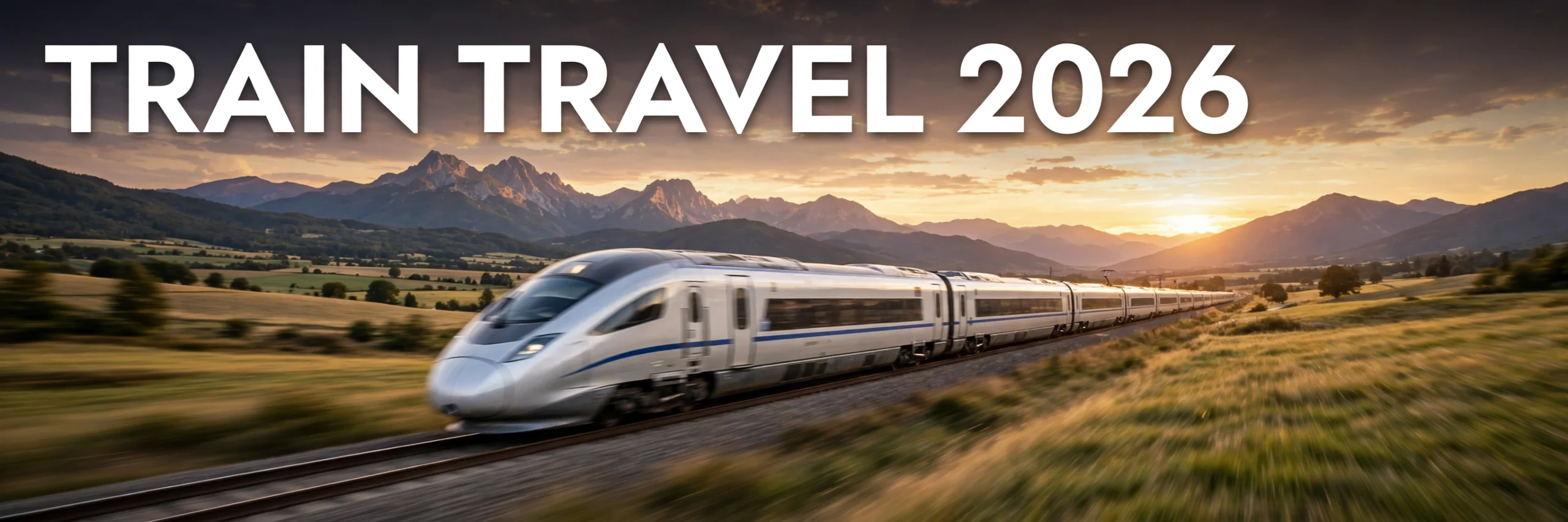
Train travel is having its biggest moment in decades. New cross-border routes are launching across Europe, India is planning seven bullet train corridors, and luxury rail journeys are selling out months ahead. Here is your complete guide to train travel in 2026: the new routes, the trends, and how to plan.
Why Train Travel Is Booming in 2026
A Hitachi Rail survey of 11,000 people found one in three expects to travel more by train in the next 12 months, rising to 40% across countries over five years. The drivers are clear: trains beat short-haul flights on comfort and city-centre convenience, they are far greener per passenger, and new high-speed and sleeper services keep making rail competitive. Railbookers reports its UK bookings up 186% year over year, with Germany, France, Italy and Switzerland all posting huge growth.
New Train Routes Launching in 2026
Paris-Berlin sleeper (European Sleeper): relaunched 26 March 2026, three times a week, after OBB withdrew its service.
Paris-Munich high-speed (DB and SNCF): launching late 2026, faster and more frequent than the current daily TGV.
Prague-Copenhagen daytime service: a brand-new route linking Central Europe with Scandinavia, complete with a children’s cinema.
Scandi sleeper expansion: overnight services extended deeper into Scandinavia for eco-conscious travellers.
For the full list, see TravelMedia’s roundup of 2026’s new European routes.
India’s High-Speed Rail Corridors
India’s Union Budget 2026-27 announced seven bullet train corridors as “growth connectors,” including Delhi-Varanasi, Mumbai-Pune, Chennai-Bengaluru and Hyderabad-Chennai. Journey times are projected to collapse: Delhi-Varanasi to 3 hours 50 minutes, Mumbai-Pune to just 48 minutes. Meanwhile, the Delhi-Patna Vande Bharat festival special is running 18 trips each way through November 2026 to handle festive demand.
Best Train Journeys in the World for 2026
Conde Nast Traveller’s 2026 Readers’ Choice Awards crowned the world’s top rail journeys: Scotland’s Royal Scotsman at number one, followed by Rovos Rail in Africa, the Britannic Explorer, the Venice Simplon-Orient-Express, India’s Maharaja Express, Canada’s Rocky Mountaineer, Switzerland’s Glacier Express and Australia’s Ghan. From glass-domed mountain cars to private-spa sleepers, luxury rail has become a destination in itself.
Train Booking Trends for 2026
Travellers are booking earlier and staying longer: the average 2026 rail vacation lasts 11 days and is booked 11 months ahead. Eastern Europe is the rising star, with Hungary, Croatia and the Czech Republic emerging as fast-growing rail hotspots. The lesson: the most popular routes and dates sell out, so plan ahead.
Tips for Planning Rail Journeys in 2026
Book sleepers and luxury trains 6-11 months out. Compare rail passes against point-to-point tickets for multi-country trips. Pack light: station transfers are easier without heavy bags. And check strike calendars and engineering works before finalizing dates, especially in France and Germany.
Frequently Asked Questions
Is train travel cheaper than flying in 2026?
Often yes for short and medium distances once airport transfers, baggage fees and city-centre arrival are counted.
What is the fastest train in the world in 2026?
China’s Shanghai Maglev remains the fastest commercial service at 460 km/h, with new high-speed corridors coming in India and Europe.
Are night trains coming back?
Yes. The Paris-Berlin sleeper relaunch and Scandi expansions mark a genuine night-train revival across Europe.
Final Words
From bullet trains to luxury sleepers, 2026 is the year of the train. Follow our business news for more on the industries on the move.
Plan ahead and book early to lock in the best fares. Overnight services and premium cabins sell out quickly on popular routes, so reserving seats several months in advance is wise. Compare rail passes against point-to-point tickets when crossing borders, as the cheaper option depends on the number of journeys and countries involved. Pack light to make station transfers and platform changes easier, and keep luggage close on busy services.
Check timetables, strike calendars, and engineering works before finalising dates, particularly in France and Germany, where disruptions are more common. Download offline maps and booking apps, carry a universal adapter, and bring snacks for longer stretches. Off-peak departures often mean quieter carriages and lower prices. Finally, enjoy the scenery: few journeys compare to watching landscapes roll past from a comfortable window seat. Slower travel lets you arrive rested, with a smaller footprint and stories to tell.
